Καλωσορίσατε

Η ερευνητική ομάδα GreenDigital αναπτύσσει ψηφιακά δίδυμα με στόχο την αντιμετώπιση προκλήσεων βιωσιμότητας.

Ανήκει στο Τμήμα Ψηφιακών Συστημάτων του Πανεπιστημίου Θεσσαλίας και λειτουργεί υπό την επίβλεψη του Αναπληρωτή Καθηγητή Ονούφριου Χαραλάμπους. Τα ερευνητικά ενδιαφέροντά μας εκτείνονται σε όλο το εύρος των εφαρμογών πράσινου και ψηφιακού μετασχηματισμού με έμφαση στους τομείς της ενέργειας, της κινητικότητας, των κτηρίων, της βιομηχανίας και της γεωργίας.

Περισσότερες πληροφορίες για τις δραστηριότητές μας δίνονται στους παρακάτω συνδέσμους:

Έργα Δημοσιεύσεις Ακαδημαϊκά Μετρήσεις

Presentation in "7th Conference on Sustainable Mobility Climate Crisis and Resilient Transportation Systems"

Haralampous, O., Samaras, N. (2025). Digital Twin of an Electric Bicycle Using Smartphone Sensors and Weather Data. In: Nathanail, E.G., Gavanas, N., Adamos, E. (eds) Climate Crisis and Resilient Transportation Systems. CSUM 2024. Lecture Notes in Intelligent Transportation and Infrastructure. Springer, Cham. https://doi.org/10.1007/978-3-031-82818-8_24

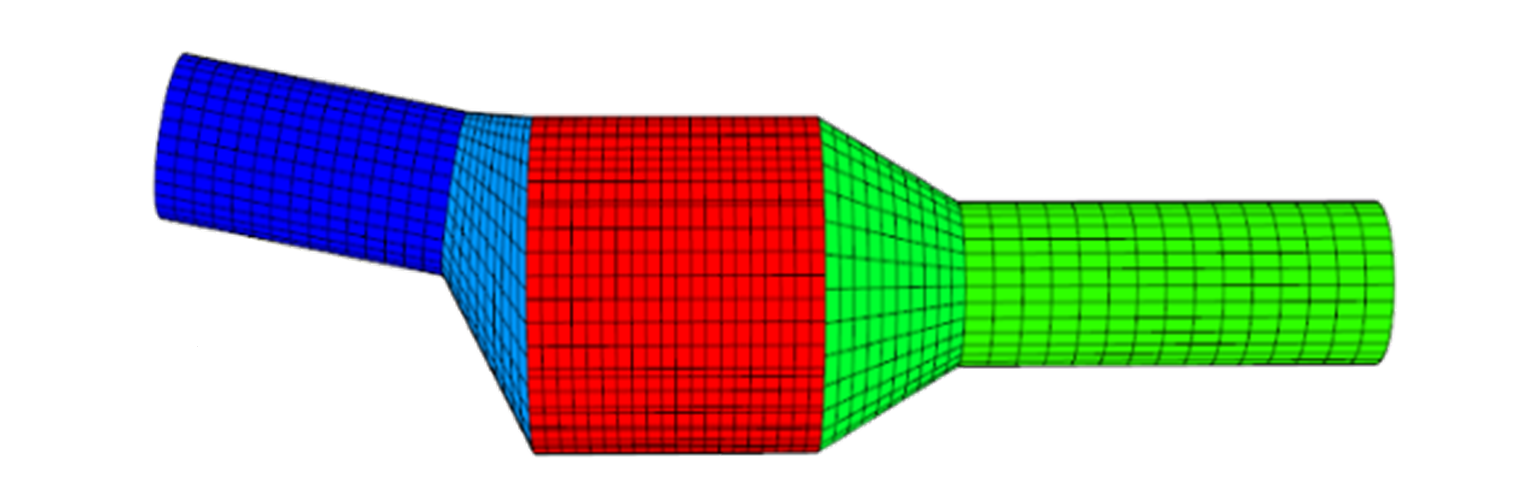
Effect of cone geometry on the efficiency of catalytic system during cold start

/posts/cone_optimization_project/case7_tilted_oblique_cone.png

The inlet geometry of an exhaust system is of critical importance for its performance during cold start . Asymmetrical inlet pipes and cones are often used upstream of close-coupled catalytic converters. As a result, flow and temperature non-uniformities arise during transient conditions, such as the cold start of the engine. A fast and and complete heat-up of the catalytic converter is critical during this period to facilitate activation of chemical reactions and emission control. Within this project a series of inlet geometries where simulated under transient conditions to assess the effects of asymmetric features. The simulations were performed with exothermia suite, which integrates Crossfire, a library for 3d mesh generation and OpenFOAM interface developed by the University of Thessaly.

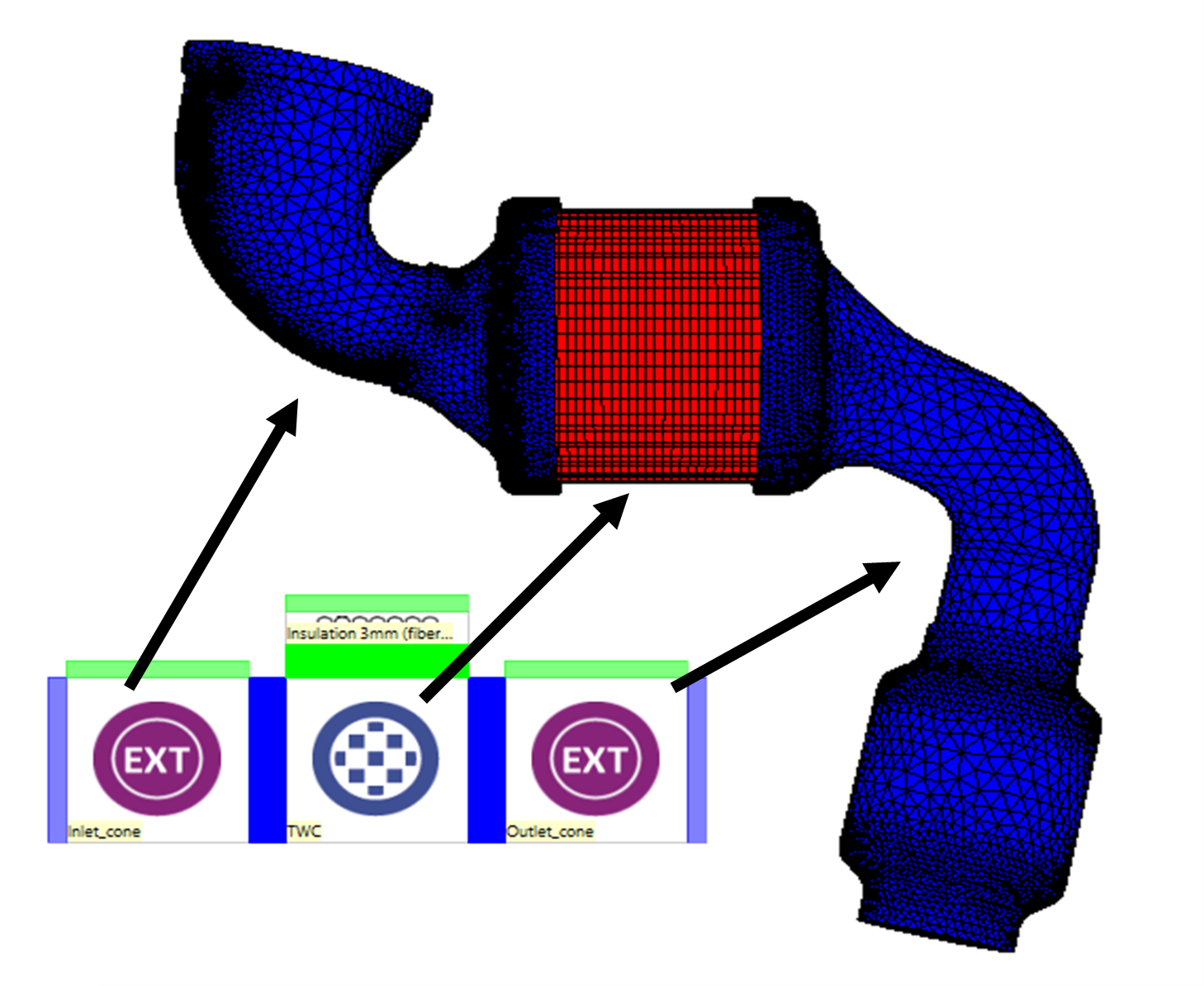
Support of free-form components in the coupling of catalyst simulation software with OpenFOAM

/posts/freeform_openfoam_project/exhaust_3dmesh.png /posts/freeform_openfoam_project/exhaust_velocity_field.png

This project followed the earlier development of crossfire, a library that couples the commercial software exothermia suite and OpenFOAM for the simulation of exhaust systems with components of standard geometry. Real-life diffusers and inlet manifold deviate substantially from standard 3d geometries due to the restrictions in the engine bay and underneath the vehicle, as shown in the pictures. The 3d geometry introduces non-uniformities that need to be accurately modeled in order to predict the performance of the complete exhaust system. With the updated library all free-form components can be imported and simulated in exothermia suite, covering fully the needs of R&D for exhaust systems. All major 3d mesh file formats are supported, hence the use of third party CFD tools is unnecessary.